

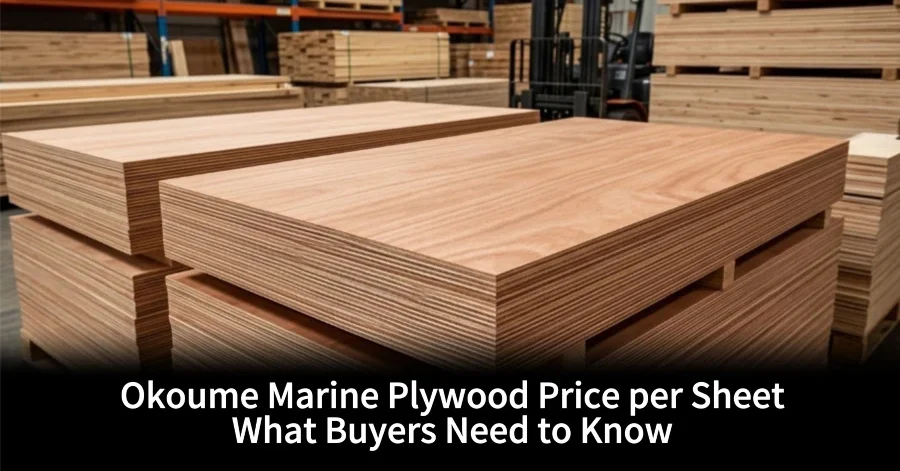
Okoume marine plywood is made from lightweight Okoumé wood sourced from Africa. Manufacturers bond the veneers with phenolic resin to improve water resistance. Marine-grade panels may also meet standards such as BS 1088, depending on their construction and certification.
For boatbuilders, marine furniture manufacturers, distributors, and importers, understanding Okoumé marine plywood prices is key to managing purchasing costs and avoiding quality issues.
How Much Does Okoume Marine Plywood Cost per Sheet?
The price of Okoume marine plywood varies by market and product specification. Retail prices in the US and Europe can differ significantly from factory-direct export prices because of transportation, distribution, import duties, and local operating costs.
The following table provides an indicative retail price reference for standard 4 × 8 ft sheets. These are budget-planning estimates rather than verified live quotations.
| Thickness | Typical Application | Indicative Retail Price (USD/Sheet) |
|---|---|---|
| 6mm (1/4 inch) | Lightweight panels and interior boat components | $45–$75 |
| 9mm (3/8 inch) | Cabinetry, partitions, and light marine structures | $60–$95 |
| 12mm (1/2 inch) | Marine furniture and bulkheads | $80–$120 |
| 18mm (3/4 inch) | Heavier panels and structural applications | $110–$175 |
| 25mm (1 inch) | Specialized heavy-duty applications | $160–$250+ |
Price Differences by Region
- Europe (e.g., the UK and France): Prices may range from £80 to £140 per sheet. Although Okoumé is sourced mainly from West Africa, including Gabon, labor and compliance costs can affect local prices.
- North America (e.g., the US and Canada): Imported sheets may cost around $100–$180 each, depending on shipping costs, import duties, and local distribution margins.
Actual prices vary by supplier, grade, origin, certification, and order volume. Retail pricing is not directly comparable with factory quotations. Buyers should confirm the specifications and delivery terms before using these figures for budgeting.
For bulk purchases, request a quotation based on your required thickness, sheet size, quality standard, and shipping destination.
What Factors Affect Okoumé Marine Plywood Prices?
Two sheets of Okoumé marine plywood can have very different prices. The main reasons include thickness, grade, core construction, adhesive quality, sheet size, and order volume.
1. Plywood Thickness and Number of Plies
Thickness is one of the biggest factors affecting the price of Okoumé marine plywood.
Thicker panels generally cost more because they use more wood and require more material during production. The number of plies also matters. Marine plywood typically uses an odd number of veneers, with each layer arranged crosswise to improve stability and strength.
Be careful with panels that cost less than expected. Some may have fewer plies or fall short of their stated thickness. For example, a sheet sold as 18 mm plywood may measure only 16 mm. Always check the actual thickness before placing a bulk order.
2. Plywood Grade and Certification
The grade and certification of a panel can have a significant impact on its price.
BS 1088 is a recognized standard for marine plywood. If your project requires BS 1088-compliant panels, ask the supplier for supporting documents and confirm that the product meets the required specifications.
Some suppliers sell products as marine plywood or exterior plywood without the same certification or construction requirements. These products may cost less, but they are not necessarily suitable for projects that specifically require BS 1088 compliance.
3. Core Material and Veneer Quality
Okoumé marine plywood can vary in face veneer quality, core material, veneer arrangement, and overall construction.
Panels made entirely from Okoumé veneers may cost more than those with Okoumé faces and mixed hardwood or other wood species in the core. These differences can also affect weight, appearance, workability, and overall performance.
For boatbuilding and other demanding applications, ask the supplier to specify the core material and explain how the panel meets your project requirements.
Don’t compare products based on the word “Okoumé” alone. Check the full construction and specifications before making a decision.
4. Bonding Quality and Moisture Resistance
Adhesive quality is another important factor in marine plywood pricing.
Marine plywood uses durable, moisture-resistant bonding to withstand damp conditions. However, waterproof glue does not make the wood itself waterproof or rot-proof. Proper sealing and maintenance still matter.
Before buying, check the adhesive type and the product’s compliance with the relevant marine plywood standard. You should also review formaldehyde emission requirements if they apply to your project.
Keep in mind that CARB Phase 2 (CARB P2), CE marking, and E0 or ENF emission classifications serve different purposes. They are not interchangeable and do not, on their own, prove that a panel meets marine plywood requirements.
5. Sheet Size and Custom Specifications
Standard 4 × 8 ft sheets are widely used in the international plywood market. Suppliers may also offer metric sizes, such as 1220 × 2440 mm, along with other dimensions for specific projects.
Custom sizes, non-standard thicknesses, additional sanding, and other processing requirements can increase the final price.
When requesting a quote, specify the sheet dimensions and acceptable thickness tolerances. This makes it easier to compare offers from different suppliers on a like-for-like basis.
6. Order Volume and Shipping Costs
Wholesale buyers can often secure lower per-sheet prices than customers buying individual sheets from retailers.
Larger orders may reduce the cost per sheet through more efficient production, packing, and shipping. However, the actual savings depend on the supplier’s minimum order quantity (MOQ), production capacity, and shipping arrangements.
For imported Okoumé marine plywood, remember to factor in freight, insurance, import duties, and local delivery charges. Ask whether the quotation covers factory pickup, port delivery, or shipment to your destination.
For an accurate comparison, check both the unit price and the total landed cost. A lower factory price does not always mean a lower overall purchasing cost.
Okoume Marine Plywood vs. Standard Okoume Plywood: Which Costs More?
Marine-grade Okoume plywood generally costs more than standard Okoume-faced plywood when comparing similar dimensions and thicknesses. The difference depends on construction, bonding requirements, veneer quality, and certification.
| Feature | Marine-Grade Okoume Plywood | Standard Okoume-Faced Plywood |
|---|---|---|
| Main applications | Boat building and demanding marine environments | Furniture and interior decoration |
| Bonding requirements | Specified for the required marine performance | Depends on the product grade |
| Core construction | Must meet the applicable specification | Varies by manufacturer |
| Certification | May require BS 1088 or other project-specific documentation | Depends on buyer requirements |
| Price level | Usually higher for comparable dimensions | Often more economical |
| Best buying approach | Verify compliance and test documents | Match the panel to its intended use |
The key difference is not simply the surface veneer. Marine plywood must be evaluated according to the required construction and performance criteria.
If your project does not require a marine-grade specification, a suitable exterior or furniture-grade panel may offer better value. If the project specifies marine plywood, choosing a cheaper substitute without checking compliance could create costly problems later.
Who Should Buy Okoume Marine Plywood in Bulk?
Wholesale Okoume marine plywood can be suitable for several types of buyers.
Boat builders and shipyards: Need lightweight panels that meet project-specific marine construction requirements.
Marine furniture manufacturers: Require consistent thickness, surface quality, and machining performance.
Plywood distributors and importers: Need stable supply, competitive pricing, and repeatable product specifications.
Construction and renovation companies: May use suitable marine-grade panels for applications exposed to demanding moisture conditions.
The correct product depends on the application. Buyers should confirm that the selected panel meets the relevant technical requirements rather than assuming every Okoume plywood product is interchangeable.
Get a Quote for Okoume Marine Plywood
Choosing the right Okoume marine plywood means balancing price, quality, and long-term performance. Before placing an order, confirm the required specifications, compare equivalent quotations, and calculate the total delivered cost.
For importers, distributors, and manufacturers, working with a reliable plywood supplier can help improve purchasing efficiency and maintain consistent product quality.
Contact AEWWOODS to discuss your plywood requirements, including available sizes, thicknesses, product specifications, and bulk-order options. Share your target quantity and destination so the team can help you evaluate a suitable quotation.
Request a quote today and find the right plywood solution for your project.