

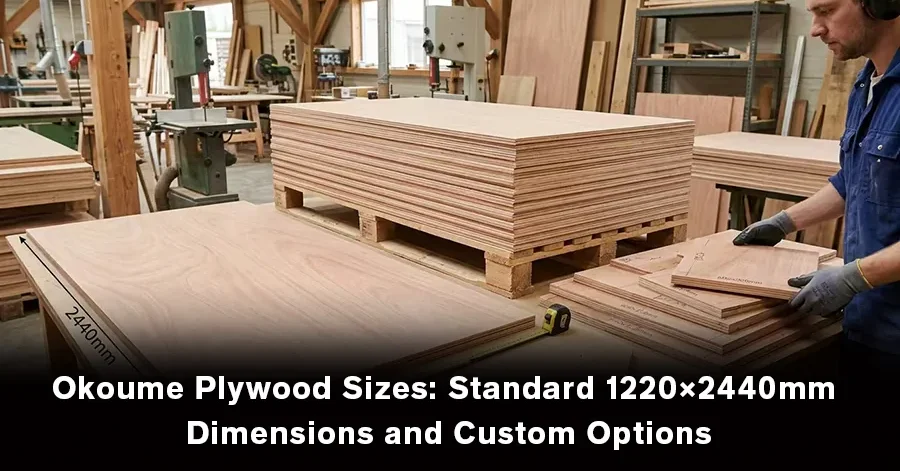
The most common size for Okoume plywood is 1220 × 2440 mm (4 × 8 ft). However, manufacturers can offer different thicknesses, sheet sizes, and processing options to suit specific project needs.
In this guide, we’ll cover standard Okoume plywood dimensions and available customization options. You’ll learn how to choose the right size for your project.
What Is the Standard Okoume Plywood Size?
The standard Okoume plywood sheet size is 1220×2440mm, equivalent to approximately 4×8 feet. This dimension is widely used in the international plywood market because it offers a practical balance between material coverage, handling convenience, and production efficiency.
A standard 1220×2440mm sheet covers approximately 2.98 square meters, making it suitable for furniture manufacturing, wall panels, cabinet components, and many construction applications.
Here are the common specifications to consider when sourcing Okoume plywood.
| Parameter | Common Specification |
|---|---|
| Standard sheet size | 1220×2440mm (4×8 ft) |
| Other available sizes | 1250×2500mm, 1200×2400mm, subject to availability |
| Thickness range | Approximately 3–40mm, depending on the manufacturer |
| Common thicknesses | 3, 4, 6, 9, 12, 15, 18, 21, 25mm |
| Surface material | Okoume veneer |
| Core material | Poplar, eucalyptus, hardwood, or mixed core, depending on the product |
| Edge condition | Square edge or customized processing |
| Special options | Sanded surfaces, cut-to-size panels, and selected bonding options |
Note: Actual dimensions, thickness availability, core construction, and tolerances vary by manufacturer and product specification. Contact AEWWOODS to confirm available options before placing a bulk order.
Customization Options for Okoume Plywood
If your project has specific size or design requirements, most manufacturers can customize Okoume plywood to fit your needs. Here are a few things to keep in mind:
- Custom Thickness: In addition to standard options, manufacturers may offer custom thicknesses from 2.8 mm to 28 mm. Non-standard thicknesses may require press adjustments, which can extend production time.
- Custom Length and Width: Manufacturers can cut panels to match your drawings or project dimensions, including non-standard sizes such as 1220 × 1800 mm. Custom cutting may add processing costs and result in some material waste.
- Custom Surface and Core Materials: You can also choose different surface finishes, such as melamine paper, natural wood veneer, or film. Core options may include poplar, pine, or birch. These choices help you meet specific requirements for moisture resistance, load-bearing performance, and environmental standards.
- Check the Minimum Order Quantity (MOQ): Manufacturers often set a minimum order quantity for custom sizes or special thicknesses. They may calculate it by sheet or cubic meter. If you only need a small quantity, buying standard-size panels and cutting them to fit may be the more cost-effective option.
Common Okoume Plywood Thicknesses and Applications
When selecting Okoume plywood, thickness is just as important as sheet size. The appropriate thickness depends on the required strength, panel support, weight, and intended application.
3–6mm Okoume Plywood
Thin Okoume plywood is suitable for lightweight interior components, decorative panels, curved furniture elements, and applications requiring easy cutting.
Its relatively low weight makes it convenient for projects where handling and surface appearance are important. However, thin panels generally require adequate support to prevent bending or damage.
9–12mm Okoume Plywood
These thicknesses are commonly considered for cabinet components, furniture backs, decorative wall panels, and lightweight partitions.
They offer greater rigidity than thinner panels while remaining relatively easy to handle and process. The final choice should depend on the panel’s span, loading conditions, and installation method.
15–18mm Okoume Plywood
For furniture manufacturing and cabinetry, 15mm and 18mm Okoume plywood are practical options.
Typical applications include:
- Wardrobe and cabinet components
- Shelving and furniture panels
- Interior wall cladding
- Door panels and decorative structures
- General-purpose joinery
For load-bearing shelves or structural components, check the panel grade, core construction, and expected load rather than relying on thickness alone.
21–25mm Okoume Plywood
Thicker Okoume plywood is suitable for applications that require additional rigidity and a more substantial panel.
Potential uses include heavy-duty furniture components, work surfaces, and specialized interior or marine projects. The required performance depends on the adhesive system, core quality, veneer construction, and service environment.
30–40mm Okoume Plywood
Thicker panels may be available for specialized applications or through customized production.
Because availability can vary significantly, buyers should confirm the maximum production thickness, required tolerances, and minimum order quantity directly with the supplier.
Standard Size vs. Custom Size: Which Is Better?
The right choice depends on your production process, project dimensions, and purchasing budget.
| Comparison | Standard 1220×2440mm | Custom Okoume Plywood |
|---|---|---|
| Availability | Generally easier to source | Depends on production capacity |
| Material utilization | May require additional cutting | Can reduce offcuts when planned well |
| Unit price | Often more competitive | May involve additional processing costs |
| Production lead time | Usually more predictable | May require extra production time |
| Application | General furniture and panel projects | Specialized designs and fixed dimensions |
| Ordering requirements | Standard product specifications | Detailed dimensions and tolerances |
For large-volume orders, custom sizing may reduce total production costs if it significantly lowers material waste. However, the savings depend on the supplier’s pricing, cutting charges, order quantity, and shipping arrangements.
Practical tip: Compare the total cost per usable panel rather than the price per sheet alone. A lower-priced standard sheet may require more cutting, while a custom panel may reduce labor and waste.
Frequently Asked Questions About Okoume Plywood Sizes
What is the standard size of Okoume plywood?
The most common standard size is 1220×2440mm, or approximately 4×8 feet. Other dimensions may be available depending on the manufacturer and market.
What thicknesses are available for Okoume plywood?
Common thicknesses include 3, 6, 9, 12, 15, 18, and 25mm. Some suppliers can manufacture panels up to 30–40mm thick, subject to product construction and production capability.
Can I order custom-size Okoume plywood?
Yes. AEWWOODS supports custom Okoume plywood sizes to meet different project and market requirements. You can request customized sheet dimensions, thicknesses, and other specifications based on your application and order quantity.
Is Okoume plywood suitable for marine use?
It can be suitable for certain marine applications when the panel is manufactured with appropriate bonding, veneer construction, and quality controls. Buyers should verify the product’s specifications and intended-use rating rather than assuming all Okoume plywood is marine grade.
How do I calculate the area of an Okoume plywood sheet?
Multiply the length by the width in meters.
For a 1220×2440mm sheet:
2.44 × 1.22 = approximately 2.98 m² per sheet.
To estimate the number of sheets required, divide the total panel area by 2.98 and then allow for cutting waste, defects, and the project’s cutting layout.
Conclusion: Find the Right Okoume Plywood Size for Your Project
The standard 1220×2440mm Okoume plywood sheet is a versatile option for furniture, cabinetry, interior decoration, and many other applications. When standard dimensions do not match your requirements, custom sizes, thicknesses, core materials, and surface processing may offer greater flexibility.
AEWWOODS supports custom Okoume plywood sizes and thicknesses to meet your specific project requirements.
For importers, furniture manufacturers, and wholesale distributors, the best purchasing decision comes from balancing sheet dimensions, material quality, processing costs, and delivery requirements.