

Okoume marine plywood, also known as marine plywood, is made with Okoume veneer as its face and back layers. Manufacturers bond multiple layers of veneer together with WBP phenolic resin glue. They arrange each layer with alternating grain directions and press them under high heat to create a strong, water-resistant panel.
Unlike standard plywood, Okoume marine plywood requires stricter quality control throughout production. It must also meet recognized marine plywood standards, such as BS 1088.
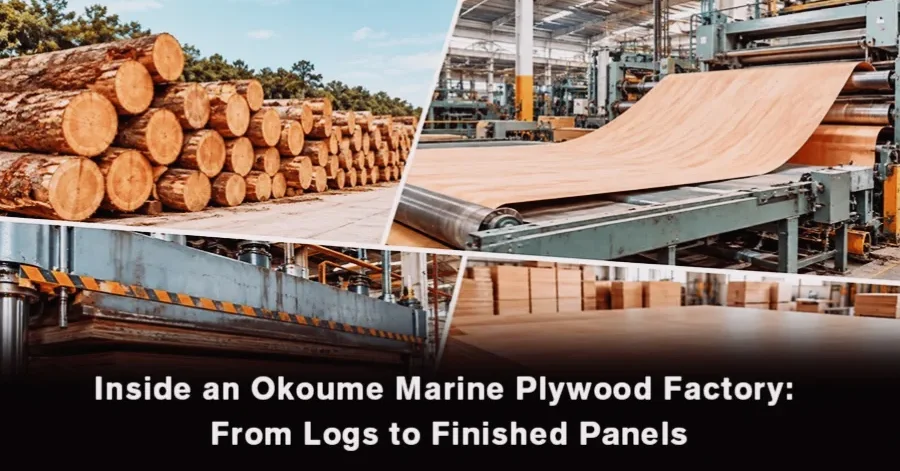
In this guide, we’ll walk you through the entire Okoume marine plywood manufacturing process, from raw materials to finished panels. You’ll learn how each production stage works and what manufacturers do to ensure consistent quality.
1. Raw Material Selection: Starting with Quality Okoume Logs
Every Okoume marine plywood production line starts with raw materials. The quality of the logs has a direct impact on the appearance and consistency of the finished plywood.
Okoume, scientifically known as Aucoumea klaineana, is a tropical hardwood species mainly sourced from Central and West Africa. It is widely used in plywood manufacturing because of its lightweight structure, smooth texture, and attractive reddish-pink color.
Before production, factory workers inspect the logs for:
- Diameter and straightness
- Cracks and surface defects
- Rot, decay, and excessive knots
- Wood condition and suitability for peeling
Selecting suitable logs helps manufacturers produce more uniform veneers and reduce unnecessary material waste.
2. Log Preparation and Veneer Peeling
After inspection, workers remove the bark and cut the logs into suitable lengths. The cutting process depends on the next production step, whether peeling or slicing.
Next, workers load the logs into a rotary peeling machine. As the logs rotate, a sharp blade cuts them into thin sheets of wood. These sheets are known as Okoume veneers.
Veneer thickness usually ranges from 0.3 mm to 2.0 mm, depending on the product design and customer requirements.
- Sliced Face Veneer: For Okoume plywood that requires a more attractive surface, manufacturers may use slicing instead of rotary peeling. This method helps preserve a more complete and natural wood grain pattern.
3. Veneer Drying: Controlling Moisture Content
Freshly peeled veneers contain a lot of moisture. Manufacturers must dry them before applying glue.
Workers feed the veneers into industrial dryers, where controlled heat removes excess moisture.
- Moisture Content: For marine plywood, manufacturers typically keep veneer moisture content between 6% and 8%. Too much moisture can lead to delamination and mold growth. If the veneers become too dry, the glue may not bond properly.
4. Veneer Grading, Sorting, and Repairing
After drying, workers sort the veneers by thickness, appearance, and quality. They repair or downgrade sheets with knots, cracks, or insect holes.
Manufacturers use different veneers for different parts of the plywood:
- Face Veneer: Used on the outer surface to provide the desired appearance and finish.
- Core Veneer: Placed between the outer layers to form the main structure of the panel.
- Back Veneer: Used on the rear side to complete the panel structure.
Factory workers can repair minor defects or remove damaged sections, depending on the required product grade.
Proper veneer sorting helps manufacturers maintain consistent panel quality and meet different customer requirements.
5. Glue Application and Veneer Layup
Applying Waterproof Adhesive: Glue application is one of the most important steps in marine plywood production.
Workers apply WBP phenolic resin glue evenly to the veneer surfaces. This adhesive gives marine plywood its strong water resistance. Standard plywood often uses urea-formaldehyde glue instead. Manufacturers must carefully control the glue spread to achieve a strong bond.
For marine applications, buyers should pay close attention to the adhesive specifications and bonding test results.
Cross-Layer Veneer Layup: After gluing, workers stack the veneers in an odd number of layers. They place each layer at a 90-degree angle to the one below it. This cross-grain structure improves panel stability and helps prevent warping.
6. Cold Pressing and Hot Pressing
After veneer layup, workers move the assembled panels to the pressing area.
Cold Pressing: Workers place the stacked veneers into a cold press for initial pressing. This step brings the layers together, helps them bond temporarily, and pushes out trapped air.
Hot Pressing: Next, the panels go into a hot press. The machine applies high temperature, usually between 140°C and 160°C, along with high pressure for a set period. The heat triggers a cross-linking reaction in the phenolic resin glue, allowing it to cure fully and form a strong bond between the veneer layers.
7. Trimming, Sanding, and Surface Finishing
After hot pressing, the plywood panels are allowed to cool before further processing.
The panels are then trimmed to the required dimensions using cutting equipment.
Common commercial dimensions include:
- 1220 × 2440 mm (4 × 8 ft)
- 1250 × 2500 mm
- 1200 × 2400 mm
- Customized dimensions
Next, the panels pass through sanding machines to achieve a smoother and more uniform surface.
Depending on customer requirements, factories can offer different face veneer grades and surface finishing options.
This stage helps prepare the panels for final inspection and export packaging.
8. Quality Inspection
- Strict Quality Control: Manufacturers check the finished panels for dimensions, surface quality, and moisture content. They also carry out random inspections to ensure consistent quality.
- Boiling Water Test: Marine plywood must pass strict water resistance tests. A common test involves boiling the panels for 72 hours to check for delamination or glue failure. Some products may also undergo salt spray testing to evaluate their resistance to corrosion.
9. Packaging and Preparation for Export
Once the panels pass inspection, they are stacked and prepared for shipment.
Export packaging is important because plywood may travel long distances and experience changes in temperature and humidity.
Common packaging methods include:
- Strong wooden pallets
- Protective plastic wrapping
- Edge and corner protection
- Customized shipping labels
- Container loading according to order requirements
Before shipment, manufacturers should also check the product quantity, specifications, packaging condition, and shipping documents.
Proper packaging helps reduce transportation damage and keeps the plywood in good condition when it reaches the buyer.
What Makes a Professional Okoume Marine Plywood Factory?
A professional Okoume marine plywood factory should have a stable raw material supply, modern production equipment, strict quality control, flexible customization, and export experience. These factors help ensure consistent product quality, efficient production, and reliable delivery.
Choosing an experienced manufacturer also helps buyers reduce purchasing risks and manage bulk orders more efficiently.
AEWWOOD specializes in Okoume plywood and Okoume veneer, serving international importers, wholesalers, and distributors. We offer customized solutions to meet different requirements.
Frequently Asked Questions
1. How long does it take to manufacture Okoume marine plywood?
Production time depends on order quantity, plywood thickness, specifications, raw material availability, and factory capacity. Buyers should confirm the production schedule before placing an order.
2. What thicknesses are available for Okoume marine plywood?
Common thicknesses range from 3 mm to 18 mm. Some manufacturers can also produce thicker panels up to 40 mm according to specific requirements.
3. What adhesive is used in Okoume marine plywood production?
Phenolic resin and other qualified waterproof adhesive systems may be used. The specific adhesive should be selected according to the required bonding performance and applicable standards.
4. How can buyers check the quality of Okoume marine plywood?
Buyers should check veneer appearance, thickness consistency, bonding strength, moisture content, dimensions, and relevant quality test reports.
5. Can an Okoume marine plywood factory produce customized sizes?
Yes. Many manufacturers offer customized thicknesses, dimensions, veneer grades, and packaging options. However, availability depends on production equipment and order requirements.
Conclusion
Inside an Okoume marine plywood factory, production involves much more than simply joining layers of wood together. From raw log selection and veneer peeling to drying, gluing, hot pressing, sanding, and final inspection, every stage contributes to the quality of the finished panels.
For international buyers, understanding this process provides a better way to evaluate manufacturers, compare product quality, and make informed purchasing decisions.
If you are sourcing Okoume marine plywood for boat building, marine interiors, or other projects, choosing an experienced manufacturer is an important step toward securing consistent product quality.