

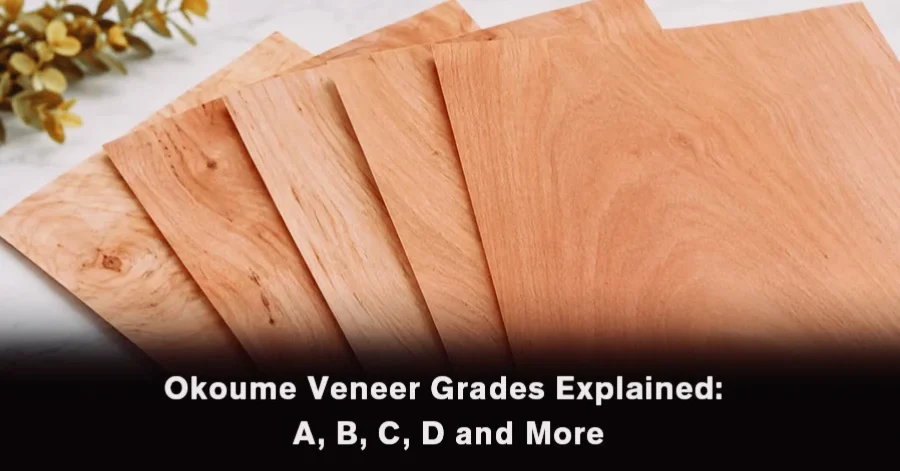
Okoume veneer is made by slicing or peeling Okoume logs into thin sheets. Manufacturers use it to make plywood, furniture, and interior decorative products.
Not all veneer sheets have the same quality. Natural wood characteristics and differences in the production process can affect the appearance and surface quality of each sheet. That’s why manufacturers sort Okoume veneer into different grades to meet various needs.
When buying Okoume veneer, you’ll often come across grades such as A, B, C, D+, D, E, and F. Each grade reflects the veneer’s surface appearance, visible defects, and overall quality. Knowing these differences can help you choose the right veneer for your project.
In this guide, we’ll take a closer look at each Okoume veneer grade, explain its key features, and help you find the right option for your needs.
What Determines Okoume Veneer Grades?
Okoume veneer grades describe the appearance and surface quality of each veneer sheet.
During production, manufacturers inspect each sheet for several key features, including:
- Color Variation: Does the veneer have a consistent natural color, or does it show noticeable discoloration?
- Knots: This is one of the most important grading factors. Manufacturers check whether knots are sound or dead, as well as their number and size. Lower grades generally allow more knots and larger defects.
- Holes: These include pinholes, wormholes, and larger openings on the veneer surface.
- Splits and Cracks: Manufacturers check for small splits and larger cracks that may affect the sheet’s appearance.
- Surface Smoothness: Is the surface clean and smooth, or does it show rough areas and visible processing marks?
- Wood Fibers: Loose fibers and other fiber defects can affect the overall surface appearance.
Manufacturers use these features to sort Okoume veneer into different quality grades.
Keep in mind that grading systems can vary between manufacturers and markets. An A-grade veneer from one supplier may not meet the same standards as an A-grade veneer from another. Before placing a bulk order, buyers should always check the supplier’s grading specifications and review actual samples.
Okoume Veneer Grades Comparison
The following table provides a quick overview of the different grades.
| Veneer Grade | Surface Quality | Main Characteristics | Typical Applications |
|---|---|---|---|
| A Grade | Excellent | Clean surface, no noticeable holes or splits | Decorative plywood, furniture |
| B Grade | Good | Slight discoloration, small cracks | Commercial plywood, furniture |
| C Grade | Medium | Medium discoloration, small holes, light fibers | General plywood production |
| D+ Grade | Lower | Discoloration, splits, bean-sized holes | Core materials, commercial plywood |
| D Grade | Low | More visible defects and larger holes | Hidden layers, general plywood |
| E Grade | Very Low | Larger holes, splits, discoloration | Low-grade plywood |
| F Grade | Lowest | Large holes and significant defects | Limited production use |
Note: This comparison follows AEWWood’s grading descriptions. Actual acceptance criteria may vary depending on the supplier, production requirements, and approved samples.
Different Types of Okoume Veneer Grades Explained
Okoume veneer is commonly available in A, B, C, D+, D, E, and F grades. Each grade has different surface characteristics and is suitable for different production requirements.
1. A Grade Okoume Veneer
A Grade Okoume veneer offers the highest surface quality in this grading system. It has a clean, smooth appearance with very few visible defects.
Its main characteristics include:
- No noticeable discoloration.
- No fiber defects.
- No holes or open splits.
- Smooth and clean surface.
- Uniform and attractive natural wood appearance.
A Grade veneer is suitable for applications where surface appearance is particularly important.
If your project requires a clean surface with minimal visible imperfections, A Grade Okoume veneer is a suitable choice.
2. B Grade Okoume Veneer
B Grade Okoume veneer has a good overall appearance but allows a few minor imperfections compared with A Grade.
Typical characteristics include:
- Slight discoloration.
- Small cracks.
- No noticeable holes.
- No significant fiber defects.
- Generally acceptable surface quality.
B Grade provides a balance between appearance and purchasing cost. It is a practical option for buyers who need relatively good surface quality without paying for the highest grade.
3. C Grade Okoume Veneer
C Grade Okoume veneer contains more visible natural and processing imperfections than A and B grades.
Its common characteristics include:
- Medium discoloration.
- Small pinholes or borer holes.
- Light fiber defects.
- Minor surface irregularities.
- Some visible knots and natural color variations.
Although C Grade has more imperfections, it remains useful for plywood production and applications where a perfect decorative surface is not necessary.
C Grade can help manufacturers control raw material costs while maintaining suitable production quality.
4. D+ Grade Okoume Veneer
D+ Grade is a lower commercial grade with more noticeable surface imperfections.
Typical characteristics include:
- Visible discoloration.
- Some splits.
- Bean-sized holes.
- Light fiber defects.
- More noticeable natural surface variations.
Compared with C Grade, D+ Grade generally allows more visible defects. However, it can still be used in suitable plywood production processes.
5. D Grade Okoume Veneer
D Grade Okoume veneer has more noticeable defects than D+ Grade.
Its main characteristics include:
- Visible discoloration.
- Surface splits.
- Larger holes, with the accepted size and quantity defined by the supplier.
- Light fiber defects.
- More noticeable surface imperfections.
D Grade is generally selected for applications with lower appearance requirements.
6. E Grade Okoume Veneer
E Grade is a lower-quality option with more significant surface imperfections.
Its typical characteristics include:
- Noticeable discoloration.
- Visible splits.
- Larger holes.
- More obvious natural and processing defects.
E Grade can be an economical option when the final product does not require an attractive exposed surface.
7. F Grade Okoume Veneer
F Grade represents the lowest quality category in this grading system.
It may contain:
- Large holes.
- Noticeable splits.
- Significant discoloration.
- Extensive fiber defects.
- Other major surface imperfections.
F Grade is generally unsuitable for applications requiring a clean and continuous veneer surface.
Applications of Different Okoume Veneer Grades
| Okoume Veneer Grade | Recommended Applications |
|---|---|
| A Grade | High-end furniture, decorative plywood surfaces, cabinet doors, premium interior panels |
| B Grade | Commercial furniture, wardrobe panels, cabinet components, plywood face veneer |
| C Grade | General-purpose plywood, commercial panels, laminate-covered furniture components |
| D+ Grade | Plywood internal layers, non-visible surfaces, economical panel production |
| D Grade | Plywood core layers, hidden furniture components, non-decorative panels |
| E Grade | Low-grade commercial plywood, internal layers, cost-sensitive panel production |
| F Grade | Selected low-grade plywood applications and other uses based on actual sheet condition |
Note: The recommended applications are general guidelines. Actual suitability depends on veneer condition, processing requirements, and the manufacturer’s grading standards.
What Is the Difference Between A Grade and B Grade Okoume Veneer?
A Grade and B Grade Okoume veneer are both used in plywood and furniture production. However, they differ in surface appearance and defect acceptance.
A Grade has a cleaner and more consistent surface. It is a better choice for applications where the natural wood appearance will remain visible.
B Grade allows slight discoloration and small cracks. Although its appearance is not as uniform as A Grade, it can still meet the requirements of many commercial applications.
The main differences are:
| Comparison | A Grade | B Grade |
|---|---|---|
| Color | More consistent | Slight discoloration allowed |
| Surface | Cleaner and smoother | Minor imperfections allowed |
| Holes | Not allowed | Not allowed |
| Cracks | No open splits | Small cracks may be accepted |
| Appearance | Premium | Commercial quality |
| Cost | Generally higher | Generally lower |
If you plan to use a transparent finish, A Grade is usually the better option. If the plywood will be painted, covered, or used in less visible areas, B Grade may provide better value.
Why Choose AEWWood for Okoume Veneer?
Choosing a reliable Okoume veneer supplier is just as important as selecting the right grade.
AEWWood provides different grades of Okoume veneer to meet the requirements of plywood manufacturers, furniture factories, and international wood product buyers.
Our available grades include A, B, C, D+, D, E, and F, giving buyers more flexibility when selecting materials for different production needs.
We focus on:
- Multiple Grade Options: Different veneer grades for different production requirements.
- Quality Inspection: Surface conditions are checked and classified according to grading requirements.
- Customized Specifications: Veneer dimensions and other specifications can be discussed according to your needs.
- Export Experience: Support for international buyers and bulk orders.
- Professional Assistance: Help selecting suitable veneer grades based on your final application.
Whether you need high-quality Okoume veneer for decorative plywood or economical materials for commercial production, our team can help you find a suitable option.
Contact AEWWood today to discuss your Okoume veneer requirements and request product details.