


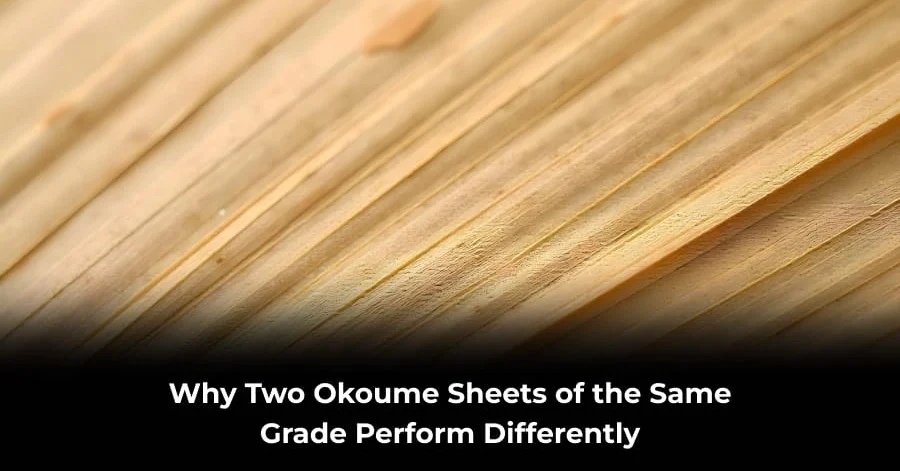
If you’ve ever worked with okoume marine plywood or sourced okoume wood for a project, you may have noticed something puzzling:
two sheets labeled the same grade can behave very differently in real-world use.
One bends more smoothly.
Another absorbs resin unevenly.
One lasts longer in moisture-heavy environments, while the other shows early fatigue.
So what’s going on?
The answer lies deeper than surface grading. From forest conditions and veneer composition to manufacturing variables and supplier practices, multiple hidden factors influence how okoume timber actually performs even within the same grade.
This blog breaks it all down clearly, practically, and honestly so buyers, builders, and manufacturers can make smarter decisions and avoid costly surprises.
Understanding Okoume: A Quick Primer
Okoume (Aucoumea klaineana) is a lightweight tropical hardwood native to Central Africa, especially Gabon. It’s widely valued for:
- Excellent strength-to-weight ratio
- Smooth surface finish
- High workability
- Strong performance in marine and exterior applications
This makes okoume marine plywood a go-to choice for boatbuilding, cabinetry, interiors, and structural panels.
However, okoume wood is a natural material and nature is rarely uniform.
What a “Grade” Really Means in the Wood Grading System
Most buyers assume grading equals performance consistency. In reality, the wood grading system primarily evaluates visible characteristics, not internal behavior.
Grades typically assess:
- Face veneer appearance
- Knot size and frequency
- Surface defects
- Repairs and plugs
What grading does not fully control:
- Fiber density variation
- Growth stress
- Moisture movement behavior
- Veneer orientation and bonding quality
This is why two sheets with the same grade stamp can perform differently once installed.
1. Tree Origin and Growing Conditions Matter More Than You Think
No two okoume trees grow under identical conditions.
Factors influencing performance include:
- Soil mineral content
- Rainfall consistency
- Tree age at harvest
- Growth rate and ring density
Even within Gabon, micro-climates can alter wood characteristics. Slower-growing trees often produce denser, more stable okoume timber, while faster-growing trees may yield lighter but less dimensionally stable sheets.
Grade labels don’t account for this biological variability.
2. Veneer Composition and Layer Balance
In plywood, performance depends heavily on how veneers are assembled not just how they look.
Two okoume sheets of the same grade may differ in:
- Core veneer thickness consistency
- Grain direction alignment
- Symmetry of veneer layers
If the internal plies aren’t evenly balanced, the sheet may:
- Warp under humidity changes
- Bend unevenly
- Respond poorly to load stress
This is especially critical in okoume marine plywood, where structural reliability is non-negotiable.
3. Moisture Content at Manufacturing Time
Moisture is one of the most underestimated variables in okoume wood performance.
Differences occur when:
- Veneers are not dried uniformly
- Pressing happens before moisture equalization
- Storage conditions vary before shipping
Sheets produced with uneven moisture content may pass grading inspections but later:
- Delaminate
- Shrink or swell inconsistently
- Lose bonding strength
Reputable hardwood timber suppliers closely monitor moisture levels throughout processing not just at the final stage.
4. Adhesive Quality and Pressing Parameters
Glue isn’t just glue.
Two sheets of okoume plywood with the same grade can differ dramatically based on:
- Adhesive formulation
- Spread rate
- Press temperature and pressure
- Press duration
Marine-grade panels require high-performance adhesives that withstand humidity, salt exposure, and thermal movement.
Subtle variations in pressing parameters can result in:
- Strong, long-lasting bonds
- Or premature internal failure despite identical grading
5. Human Skill and Manufacturing Discipline
Wood is processed by people, not machines alone.
Differences arise from:
- Veneer selection judgment
- Layer alignment precision
- Quality control rigor
Facilities that treat grading as a minimum standard rather than a quality benchmark often produce inconsistent results even within the same grade batch.
This is why choosing experienced hardwood timber suppliers matters as much as the product itself.
6. Storage, Transport, and Handling After Production
Performance differences don’t stop at the factory gate.
Improper handling can compromise even high-grade okoume sheets:
- Exposure to excess humidity during shipping
- Poor stacking practices
- Lack of acclimatization before use
Trusted suppliers and a professional woodworking supplies store in Gabon ensure panels are stored and transported under controlled conditions to preserve integrity.
Why This Matters for Buyers and Builders
Understanding these variables helps you:
- Choose suppliers, not just grades
- Reduce project failure risk
- Improve long-term durability
- Optimize cost vs performance
Grades are a starting point, not a guarantee.
Why Supplier Expertise Is the Real Differentiator
When sourcing okoume timber, consistency comes from process control, not labels.
Reliable suppliers:
- Source logs responsibly
- Maintain strict veneer selection standards
- Control moisture and bonding quality
- Follow international marine plywood norms
This is especially important for buyers sourcing from a woodworking supplies store in Gabon, where proximity to raw material must be matched with technical discipline.
About AEW Woods
AEW Woods is known for its commitment to quality, transparency, and consistency in African hardwood sourcing. By combining responsible forestry practices with strict manufacturing oversight, AEW Woods ensures that okoume marine plywood, okoume wood, and okoume timber deliver predictable performance not just acceptable grades.
Their approach emphasizes:
- End-use suitability over surface appearance
- Stable supply chains
- International compliance standards
For buyers seeking reliability beyond grading labels, AEW Woods represents a supplier-led quality advantage.
Conclusion: Same Grade Doesn’t Mean Same Performance
Two okoume sheets of the same grade can perform differently because grading measures appearance, not the full life behavior of wood.
True performance depends on:
- Tree origin
- Veneer balance
- Moisture control
- Adhesive systems
- Manufacturing discipline
- Supplier expertise
If you want consistency, longevity, and confidence, look beyond the stamp. Choose knowledgeable hardwood timber suppliers and trusted sources for okoume marine plywood especially when sourcing from a professional woodworking supplies store in Gabon.
Frequently Asked Questions:
- Why does okoume marine plywood from the same grade vary in durability?
Because grading focuses on surface quality, not internal veneer balance, moisture content, or adhesive performance.
- Is okoume wood considered a hardwood?
Yes. Okoume is classified as a tropical hardwood, though it is lighter than many other hardwood species.
- How can I ensure consistent okoume timber performance?
Work with experienced hardwood timber suppliers who control sourcing, processing, and quality beyond grading standards.
- Does the wood grading system guarantee marine performance?
No. Marine performance depends on adhesives, pressing quality, and moisture control—not grade alone.
- Why source from a woodworking supplies store in Gabon?
Gabon offers direct access to premium okoume logs, and professional suppliers there can ensure better traceability and quality control when done right.