

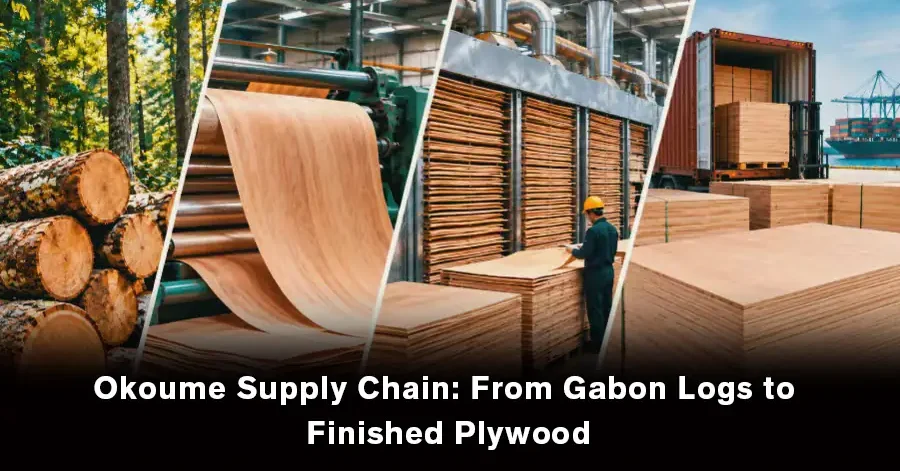
The Okoume supply chain starts with carefully selected logs in Central Africa and continues through log processing, veneer production, plywood manufacturing, quality inspection, and international export. For B2B buyers, understanding these stages can make it easier to evaluate product consistency, traceability, and supplier reliability.
Okoume is widely used for plywood, veneer, furniture components, interior applications, and marine products because of its lightweight characteristics and good workability. However, the quality of the finished material depends not only on the plywood factory but also on how the raw material is selected and processed from the beginning.
1. Okoume Logs: The Starting Point of the Supply Chain
The first stage of the Okoume supply chain is the sourcing and selection of Okoume logs. Okoume is native to Central Africa, with Gabon being an important source of this species.
At this stage, factors such as log diameter, straightness, defects, moisture condition, and usable volume can affect the efficiency of later processing. Therefore, proper log selection helps manufacturers obtain more usable veneer and maintain a more consistent raw material supply.
In addition, knowing the origin of the logs is useful for B2B buyers who need to evaluate traceability and responsible sourcing requirements.
2. Log Processing and Veneer Production
After logs arrive at the processing facility, they are prepared for veneer production. First, the logs are debarked and processed into thin sheets of wood veneer using rotary peeling or other suitable methods.
As a result, the condition of the logs has a direct effect on veneer yield and quality. Veneer thickness consistency, surface condition, knots, splits, and other natural characteristics need to be controlled during production.
For example, suitable log selection can help manufacturers produce veneer with fewer major defects and more consistent dimensions. This is particularly important when the veneer will be used for visible plywood surfaces.
Learn more about the material itself on our Okoume Wood Veneer product page.
3. Veneer Drying and Grading
Freshly peeled veneer contains moisture and normally needs controlled drying before it can be used in plywood production. Therefore, the drying process helps bring the veneer to a suitable moisture condition for bonding and pressing.
After drying, veneers can be sorted according to their appearance and intended use. Higher-quality face veneers may be selected for visible surfaces, while other grades can be used in core or back layers depending on the plywood construction.
In particular, consistent drying and grading are important parts of the Okoume plywood supply chain. They can influence bonding quality, surface appearance, and dimensional stability.
4. From Okoume Veneer to Finished Plywood
The next stage is plywood manufacturing. First, veneer sheets are arranged into multiple layers, with the grain direction normally alternating between adjacent layers. Then, adhesive is applied between the veneers before the panel is assembled and pressed.
During pressing, the veneers are bonded into a cross-laminated panel. Afterward, the plywood can go through processes such as trimming, sanding, panel inspection, and grading.
Depending on the required application, manufacturers may produce different constructions, thicknesses, surface grades, and bonding specifications. For this reason, buyers should confirm the exact plywood structure and technical requirements before placing a bulk order.
For product specifications, applications, and available options, see our Okoume Plywood product page.
5. Quality Control Along the Okoume Supply Chain
Quality control should not begin only after the plywood has been produced. Instead, a reliable supply chain checks the material at several stages, from raw logs and veneer to finished panels.
- Log inspection: First, check species, dimensions, defects, and usable volume.
- Veneer inspection: Next, check thickness, moisture, surface condition, and defects.
- Panel inspection: Then, check dimensions, bonding, surface quality, and construction.
- Final inspection: Finally, confirm specifications, packaging, quantity, and shipment requirements.
In this way, quality checks are distributed throughout the production process instead of being limited to the finished product. As a result, B2B buyers can gain better visibility into how the material is produced and reduce inconsistencies between shipments.
6. Why Supply Chain Control Matters for B2B Buyers
When purchasing Okoume plywood in commercial quantities, the supplier’s control over the upstream supply chain can be an important consideration. For example, multiple intermediaries may make it harder to verify raw material origin, production conditions, and product consistency.
On the other hand, a more integrated supply chain can provide better coordination between raw material sourcing, veneer production, plywood manufacturing, inspection, and export. In addition, it can make communication about specifications and custom requirements more straightforward.
If you are comparing suppliers, our guide on How to Choose a Reliable Okoume Plywood Supplier provides additional points to check before making a sourcing decision.
7. From Finished Plywood to International Markets
Once the plywood passes final inspection, the panels are prepared for packaging and export. At this stage, packaging needs to protect the sheets during handling, container loading, ocean transportation, and unloading.
Furthermore, international buyers need to consider more than product quality. Documentation, specifications, packaging, shipment planning, and traceability can all affect the efficiency of a B2B order.
AEW Wood operates in Gabon and focuses on Okoume plywood, veneer, and timber. Therefore, its supply chain can connect raw material sourcing with processing and finished wood products for international markets.
For buyers interested in the raw material rather than finished panels, you can also explore our Okoume Timber range.
Conclusion
The Okoume supply chain connects several important stages: responsible log sourcing, veneer production, drying and grading, plywood manufacturing, quality control, and international export. Overall, each stage can influence the consistency and suitability of the final product.
For B2B buyers, understanding this process makes it easier to ask the right questions about origin, veneer quality, plywood construction, inspection, and supply capacity. In addition, a supplier with clear control and traceability across these stages can provide better visibility from raw material to finished plywood.
Looking for Okoume plywood, veneer, or timber for your next project? Contact AEW Wood to discuss specifications, applications, and supply requirements.