

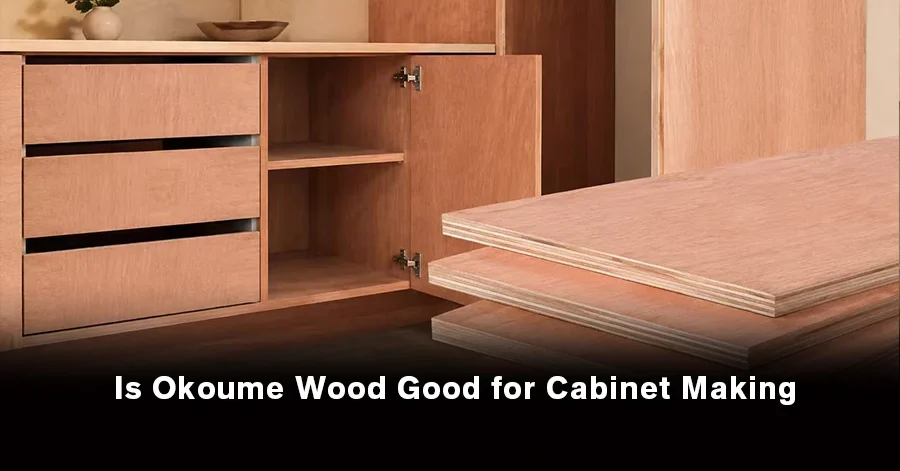
Okoume, scientifically named Aucoumea klaineana, is widely referred to on the market as African Red‑Walnut or Gabon Mahogany. Thanks to its light weight and appealing visual finish, it ranks as a fantastic cabinet‑making option. It works perfectly for homeowners who want genuine solid‑wood aesthetics while sticking to a tighter budget, earning it a reputation as great value‑for‑money timber. Even so, Okoumé comes with clear physical limitations that buyers need to consider realistically.
What Is Okoume Wood?
Okoume is a lightweight tropical hardwood species native to Central and West Africa. It is widely known for its relatively low density, attractive natural color, and good workability.
Okoume wood is commonly processed into veneers, plywood, sawn timber, and other wood products. Because the wood is lightweight and relatively easy to machine, it has become popular in furniture, interior decoration, boatbuilding, doors, and other woodworking applications.
The natural color of Okoume is generally light pinkish-brown to pale reddish-brown. Its relatively uniform appearance can provide an attractive surface for furniture and cabinet applications.
For manufacturers, Okoume wood can be processed into plywood to create larger, more dimensionally stable panels suitable for modern cabinet production.
6 Advantages of Okoume Wood for Cabinets
1. Lightweight
One of Okoume’s biggest advantages is its relatively low density, with an air‑dry density ranging from 0.45‑0.55g/cm³.
Cabinet parts made from Okoumé are far easier to transport, carry, install and handle throughout production.
Lightweight cabinet doors also place less strain on hinges and other hardware. This benefit matters most for large wardrobe doors, wall cabinets and other furniture with wide, large‑size panels.
For furniture manufacturers looking to cut down the overall weight of their finished products, Okoumé plywood makes a highly appealing option for cabinet construction.
2. Easy to Machine
Okoume machines very well with standard woodworking tools. You can easily cut, drill and sand the timber. It dries quickly after processing and delivers good dimensional stability, with low risks of large‑scale cracking or warping.
It can be used with:
- Table saws
- Panel saws
- CNC routers
- Drilling machines
- Sanding equipment
- Edge-processing machines
Its good workability allows cabinet manufacturers to produce customized shapes, holes, grooves, and other details efficiently.
This is particularly valuable for manufacturers producing custom cabinets or furniture components in different sizes.
3. Attractive Natural Appearance
Okoumé features a warm, fairly uniform natural look. It carries straight, fine‑grained texture with minimal colour variation and very few knots, delivering a smooth, clean surface.
Depending on its grade and face quality, Okoumé can be used for exposed, visible furniture surfaces or finished with decorative overlays.
It can be:
- Clear coated
- Painted
- Stained
- Veneered
- Laminated
This gives it great flexibility to fit a wide range of cabinet designs and interior styles.
Once fabricated into cabinet bodies, it delivers a strong natural‑wood feel, making it an ideal pick for rustic‑wood, minimalist and new‑Chinese interiors.
4. Suitable for Plywood Manufacturing
One of the most important commercial advantages of Okoume is its suitability for veneer production.
Instead of using solid Okoume wood, manufacturers can produce Okoume plywood by bonding multiple veneer layers together.
This provides several benefits for cabinet manufacturing:
- Larger panel sizes
- Better dimensional stability
- Efficient material utilization
- Consistent thickness
- Easier industrial production
As a result, Okoume plywood is often a more practical cabinet material than solid Okoume timber for large-scale furniture production.
5. Easy to Customize
Okoume plywood can be manufactured in different thicknesses, sizes, face grades, and core constructions.
This allows buyers to select specifications based on different cabinet components.
For example:
| Cabinet Component | Common Thickness |
|---|---|
| Back panels | 3–6 mm |
| Drawer components | 6–12 mm |
| Cabinet doors | 12–18 mm |
| Side panels | 12–18 mm |
| Cabinet carcasses | 15–18 mm |
| Shelves | 18–25 mm |
These are general ranges rather than fixed requirements. The final thickness should be determined by cabinet design, panel size, hardware, and expected load.
6. Good Option for Lightweight Furniture
If reducing furniture weight is a major consideration, Okoume can be particularly attractive.
Lightweight cabinets can be easier to move and install, which is useful for residential furniture, office furniture, wardrobes, and modular storage systems.
Key Drawbacks to Keep in Mind
Soft texture: Okoumé has a low hardness level. Deep pressure from your fingernails or knocks against sharp objects can easily leave marks on its surface. It is not as scratch‑resistant as oak or ash wood.
Limited load‑bearing capacity: It is not suited for long‑span structures or parts that need to carry extreme weight, such as basic bed frames and wide floating shelves. If you use it for cabinet shelves, we recommend adding extra thickness or support brackets.
Moisture sensitivity: It offers moderate decay resistance and can be attacked by termites and fungi. Okoumé is designed solely for indoor applications. Never use it outdoors or in spaces with constant high humidity.
What Types of Cabinets Can Use Okoume Wood?
Okoume wood and Okoume plywood can be used for a variety of cabinet applications.
Kitchen Cabinets
Okoume plywood can be used for cabinet carcasses, doors, drawer boxes, side panels, and other components.
However, kitchens can be exposed to water, steam, and humidity. Therefore, buyers should select an appropriate adhesive and surface treatment.
Special attention should also be given to cabinet edges, joints, and areas around sinks.
Wardrobes and Closets
Okoume is well suited to wardrobes, closets, and bedroom storage furniture.
Its lightweight characteristics can be beneficial for large doors and tall cabinet panels.
Living Room Cabinets
TV cabinets, bookshelves, display cabinets, and storage units can also be manufactured using Okoume plywood.
The material can be painted, laminated, or finished with decorative veneer depending on the design.
Office Furniture
Okoume plywood can also be used for office cabinets, shelving, storage units, and customized furniture.
Its combination of low weight and good machinability makes it convenient for furniture manufacturers.
Okoume Wood vs Birch Wood for Cabinet Making
When choosing cabinet materials, buyers often compare Okoume with birch.
Both materials can be suitable for furniture, but they have different characteristics.
| Feature | Okoume | Birch |
|---|---|---|
| Weight | Lightweight | Relatively heavy |
| Strength | Good | High |
| Workability | Good | Good |
| Appearance | Warm, natural | Light and uniform |
| Screw holding | Good for many uses | Generally excellent |
| Cabinet applications | Lightweight furniture | Heavy-duty furniture |
| Finishing | Easy to finish | Easy to finish |
If your priority is low weight and easy processing, Okoume can be a strong candidate.
If your project requires higher stiffness, strength, or screw-holding performance, birch plywood may be worth considering.
Therefore, there is no universal winner. The best cabinet material depends on the project requirements.
What Should Buyers Check When Buying Okoume Wood for Cabinets?
B2B buyers should evaluate the complete product specification before placing an order.
Face Quality
Check for:
- Knots
- Cracks
- Patches
- Color variation
- Open defects
- Surface smoothness
Higher face grades are generally preferable for visible cabinet surfaces.
Core Quality
Ask the supplier about the core species, veneer layers, voids, overlaps, and overall construction.
A good-looking face does not necessarily mean the entire plywood panel is high quality.
Thickness and Size
Confirm panel dimensions and thickness tolerance before mass production.
Accurate dimensions are important for CNC processing, cabinet assembly, drawer fitting, and hardware installation.
Adhesive
Select the adhesive according to the intended environment.
Interior furniture may require different adhesive performance from cabinets used in humid conditions.
Certification
Depending on the target market, buyers may require certifications or test reports related to environmental performance, formaldehyde emissions, legality of timber, or other requirements.
Always confirm the requirements of the destination market before ordering.
Final Verdict: Is Okoume Wood Good for Cabinet Making?
Yes, Okoume wood is a good option for many cabinet-making applications, particularly when buyers need lightweight, workable, and attractive wood products.
Its main strengths are its low weight, good machinability, natural appearance, finishing flexibility, and suitability for plywood manufacturing.
For large-scale cabinet production, Okoume plywood can often be more practical than solid Okoume timber because plywood provides large, consistent panels for furniture manufacturing.
If you are sourcing Okoume plywood for cabinets, wardrobes, furniture, or interior projects, Bait Wood can provide customized specifications according to your application and market requirements.
Contact AEWWOODS to discuss your Okoume plywood requirements and request product specifications or samples.
FAQ
Is Okoume wood good for kitchen cabinets?
Yes. Okoume plywood can be used for kitchen cabinets, but moisture-resistant construction, suitable adhesive, surface finishing, and edge sealing should be considered.
Is Okoume better than birch for cabinets?
Not necessarily. Okoume is lighter and easy to process, while birch generally offers higher strength and stiffness. The better choice depends on the application.
Is Okoume plywood strong enough for cabinets?
For many cabinet applications, yes. The required strength depends on thickness, core construction, panel size, and expected load.