

Okoume wood is an African hardwood widely used for furniture‑making, boatbuilding, interior finishing and all kinds of woodworking projects.
That said, buyers often run into confusing terms when sourcing Okoume timber, including Okoume lumber, Okoume sawn timber and Okoume wood stock.
These names get tossed around interchangeably quite often. Even so, their exact definitions can shift slightly, depending on the supplier, regional market and product specifications.
So what sets Okoume wood apart from Okoume sawn‑timber?
Are they genuinely separate products, or just alternative labels for the exact same raw material?
This guide breaks down their key differences, core properties, common uses and critical buying tips.
What Is Okoume Lumber?
Okoume lumber refers to wood manufactured from African Okoume logs, cut into boards, planks or other sawn sections.
It is a broad, widely‑used term in American trade, covering all semi‑processed solid Okoume timber, including green rough boards, dried planks, rough‑sawn blanks and dimension stock. No strict requirements are placed on surface finish or finished sizes.
Okoume lumber can be supplied in different dimensions, grades, moisture conditions, and surface finishes depending on the customer’s requirements.
For international buyers, Okoume lumber is often purchased directly from timber suppliers or manufacturers in Central Africa.
What Is Okoume Sawn Timber?
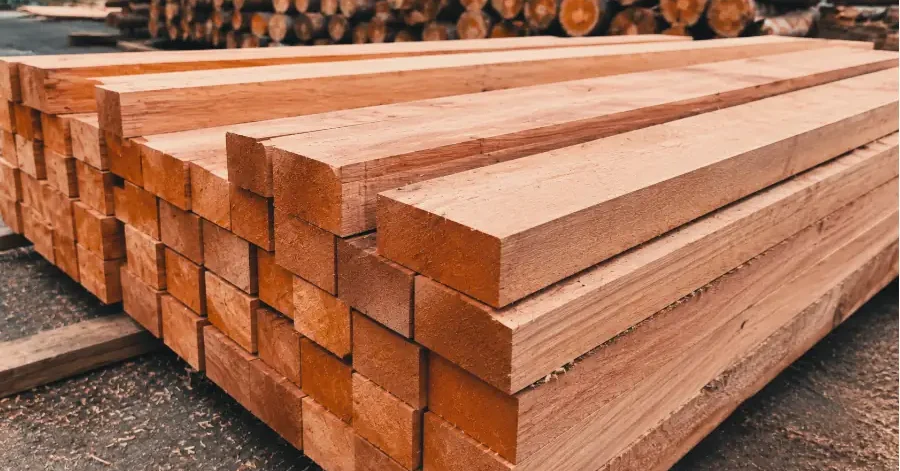
Okoume sawn‑timber is solid Okoume wood sawn directly from logs. It excludes veneers, plywood and wood offcuts. It covers green rough boards as well as kiln‑dried, graded and dimensioned finished planks.
Its typical production flow goes as follows: Okoume logs → log sorting → sawing → cutting, drying & grading → final inspection → packaging.
AEW Woods can supply Okoume sawn‑timber in rough‑sawn or further‑processed forms based on buyer requirements. Available options include rough‑sawn Okoume, kiln‑dried Okoume, air‑dried Okoume, planed Okoume boards and custom‑size Okoume timber. Standard specifications:
- Width: 150mm up
- Length: customized
- Thickness: customized
- Raw Material: Gabon Okoume Log
The term “sawn‑timber” highlights the processed form of the wood, while “lumber” serves as a broader commercial term widely used across North‑American markets. You can visit our dedicated article to explore its real‑world uses: Okoume Sawn Timber Applications.
Okoume Lumber vs Okoume Sawn Timber: Are They Different?
The short answer is: usually, not significantly.
The primary difference between okoume lumber vs Okoume Sawn Timber is terminology.
The term “lumber” generally refers to processed wood products, and it is the standard wording across the US and Canada. In contrast, “sawn‑timber” is more widely used in global wood trade and European markets.
Both can refer to wood that has been sawn from logs into usable boards or sections.
| Feature | Okoume Lumber | Okoume Sawn Timber |
|---|---|---|
| Wood species | Okoume | Okoume |
| Scientific name | Aucoumea klaineana | Aucoumea klaineana |
| Basic form | Sawn wood | Sawn wood |
| Main difference | Commercial terminology | Processing terminology |
| Typical markets | North America and international trade | Europe and international timber trade |
| Available forms | Boards, planks, sections | Rough-sawn or processed boards |
| Custom dimensions | Available | Available |
| Main applications | Furniture, boats, woodworking | Furniture, boats, construction-related woodworking |
Therefore, buyers should focus less on the terminology and more on the actual product specifications.
Tips:All Okoume sawn‑timber counts as Okoume lumber, yet not every piece of Okoume lumber qualifies as sawn‑timber.
Key Characteristics of Okoume Lumber
Before purchasing Okoume lumber, buyers should understand its main physical and processing characteristics.
1. Lightweight
One of the biggest advantages of Okoume is its relatively low weight.
This characteristic is particularly useful for boat building, transportation-related applications, and furniture where reducing overall weight is important.
For boat manufacturers, lightweight timber can help reduce the total weight of the finished structure.
2. Easy to Machine
Okoume is generally easy to saw, plane, drill, and shape.
Its good workability allows manufacturers to process it using conventional woodworking equipment.
This can help reduce machining difficulties and improve production efficiency.
3. Attractive Appearance
Okoume usually has a light pink, salmon, or reddish-brown appearance.
The grain can range from relatively straight to slightly interlocked.
After sanding and finishing, the wood can provide an attractive natural appearance for furniture and interior applications.
4. Good Veneer Potential
Okoume is widely known for its use in veneer production.
Okoume veneer is commonly used to manufacture plywood, including marine and lightweight plywood products.
The relatively lightweight structure and attractive appearance make it useful for applications where both appearance and weight are important.
5. Suitable for Marine Applications
Okoume is particularly well known in the boat-building industry.
Its low weight and good workability make it suitable for producing lightweight boat components and marine plywood.
However, buyers should distinguish between Okoume wood itself and marine-grade Okoume plywood.
Raw Okoume lumber is not automatically waterproof simply because Okoume plywood can be used in marine applications. The final performance depends on the construction, adhesive, coating, treatment, and intended application.
What Specifications Should Buyers Check?
When purchasing Okoume lumber or Okoume sawn timber, the product name should not be the only consideration.
Buyers should confirm the following specifications with the supplier.
Wood Species
Confirm that the material is genuine Okoume and specify the botanical name:
Aucoumea klaineana
This helps avoid confusion with other African hardwood species.
Dimensions
Common purchasing specifications include:
- Thickness
- Width
- Length
For large-volume orders, customized dimensions may be available depending on the supplier’s production capacity.
Moisture Content
Moisture content is an important factor when purchasing sawn timber.
For furniture and interior applications, buyers may require kiln-dried timber with a controlled moisture content.
The appropriate moisture level depends on the destination climate and final application.
Grade
Timber grades can affect:
- Knots
- Cracks
- Wane
- Color variation
- Grain quality
- Defects
- Overall yield
Buyers should establish grading standards before placing a bulk order.
Surface Condition
Specify whether the timber should be:
- Rough sawn
- S4S
- Planed
- Sanded
- Customized
For manufacturing applications, the required surface condition can affect both processing costs and final yield.
How to Choose Between Okoume Lumber and Okoume Sawn Timber?
In most cases, buyers do not need to choose between two completely different wood products.
Instead, they should specify the exact Okoume sawn timber requirements they need.
For example, instead of simply asking for “Okoume lumber,” a professional purchasing specification could include:
Okoume sawn timber, kiln dried, rough sawn, customized thickness and width, selected grade, suitable for furniture manufacturing.
This gives the supplier much more useful information.
What Should Importers Ask an Okoume Timber Supplier?
If you are buying Okoume lumber in bulk, asking the right questions before placing an order can reduce quality and shipment risks.
Consider asking:
1. What is the wood species?
Confirm that the timber is Okoume (Aucoumea klaineana).
2. Where is the timber sourced?
Ask for the timber origin and available documentation.
3. Is the timber kiln dried or air dried?
This directly affects moisture content and dimensional stability.
4. What grade is available?
Ask for detailed grading rules and photos of representative material.
5. What dimensions can you supply?
Confirm thickness, width, and length tolerances.
6. What is the moisture content?
Request the target moisture range before ordering.
7. Can you provide samples?
Samples can help buyers evaluate color, grain, defects, and machining quality.
8. How is the timber packed?
Confirm bundle size, protective packaging, and container loading details.
Conclusion: Okoume Lumber vs Okoume Sawn Timber
When comparing Okoume lumber vs Okoume Sawn‑Timber, note they fall under the same category of processed Okoume wood, not two entirely separate products.
Buyers should not focus purely on product labels. When sourcing for furniture, boatbuilding, woodworking or wholesale, clear specifications ensure stable quality and precise quotes. For bulk orders, work with AEW Woods to customize sizes, grades, drying standards and packing to fit your market needs. If you need reliable Okoume lumber or sawn‑timber for your project, reach out to AEW Woods for available grades, dimensions, moisture data and custom requirements.