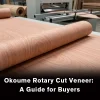


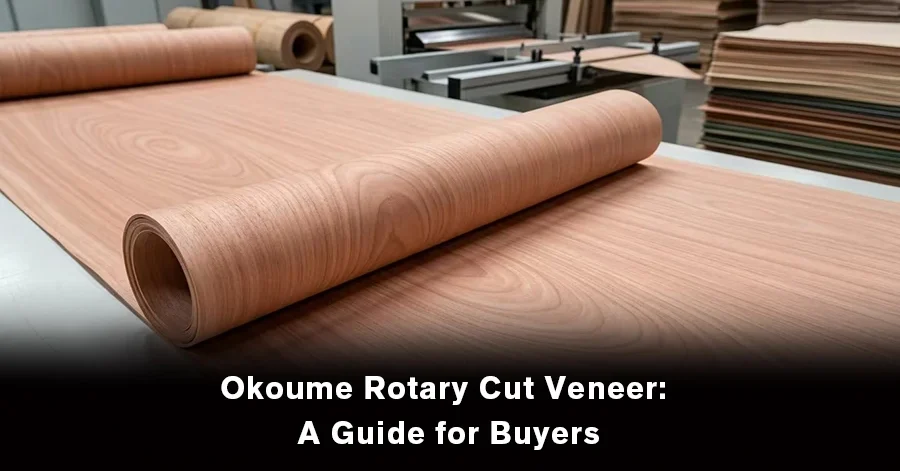
Okoume rotary cut veneer is made from African Okoume logs and produced using a rotary peeling process to create thin sheets of wood veneer. Thanks to its lightweight nature and easy workability, Okoume veneer is widely used in furniture manufacturing, home interiors, and custom cabinetry. It offers a practical and cost-effective option for projects that need a natural wood appearance without adding unnecessary weight.
What Is Okoume Rotary Cut Veneer?
Okoume (Aucoumea klaineana) is a lightweight hardwood native to West and Central Africa, particularly Gabon. Its relatively low density, fine grain, and good workability make it well suited for producing veneer and plywood.
Okoume rotary cut veneer is made by rotating a log against a cutting knife to peel off a continuous sheet of thin wood veneer. The veneer is typically produced in thicknesses ranging from 0.3 mm to 2.0 mm, while retaining the natural grain and appearance of the Okoume wood.
Unlike sliced veneer, which is cut from a log into individual sheets, rotary cutting produces a continuous ribbon of veneer. After peeling, the veneer can be trimmed, dried, graded, and packed according to the buyer’s requirements.
Why Choose Okoume Rotary Cut Veneer?
Okoume rotary cut veneer offers a combination of low weight, easy processing, attractive grain, and efficient log utilization. These qualities make it a practical choice for plywood manufacturing, furniture, cabinetry, and other engineered wood applications.
Lightweight and Easy to Handle
One of the main advantages of Okoume is its relatively low density. This makes Okoume veneer a good option for products where keeping the overall weight down is important.
For plywood manufacturers, using lightweight Okoume face or core veneers can result in panels that are easier to handle, transport, and install without adding unnecessary weight.
Easy to Process
Okoume is relatively soft and easy to work with. It can be sawn, sanded, stained, and finished with minimal difficulty, making it suitable for a wide range of painting, coating, and decorative veneer applications.
Natural and Consistent Grain
Okoume typically ranges in color from light pink to reddish brown, with a naturally warm appearance.
Because rotary cutting produces wide, continuous sheets of veneer, it works particularly well for large decorative surfaces such as cabinet doors, wall panels, and custom-built interiors. The broad cathedral-style grain created by rotary cutting can also give large surfaces a more natural and continuous look than the repetitive patterns sometimes associated with sliced veneer.
Efficient Veneer Recovery
The rotary peeling process makes efficient use of suitable logs by producing long, continuous sheets of veneer. For plywood manufacturers, good veneer recovery is an important factor when managing raw material costs and overall production efficiency.
Good Dimensional Stability
Okoume has relatively low extractive content and a mild odor. When properly processed and bonded during plywood production, Okoume veneer can provide good dimensional stability under normal changes in temperature and humidity.
As with any wood product, the final performance depends on factors such as moisture content, drying conditions, adhesive selection, and manufacturing quality.
Okoume Rotary Cut Veneer vs. Sliced Okoume Veneer
Buyers often compare rotary cut veneer with sliced veneer.
The main difference is the production method.
| Feature | Rotary Cut Okoume Veneer | Sliced Okoume Veneer |
|---|---|---|
| Production method | Log is peeled continuously | Log is sliced into individual sheets |
| Veneer pattern | More varied rotary grain pattern | More decorative grain patterns |
| Production efficiency | Generally high | Generally lower |
| Common use | Plywood and engineered panels | Furniture and decorative surfaces |
| Material utilization | Efficient for suitable logs | Depends on cutting method |
| Typical purchasing focus | Thickness, size, grade, consistency | Appearance and grain matching |
If the main goal is plywood manufacturing or large-volume panel production, rotary cut Okoume veneer can be a practical option.
If the main goal is highly controlled decorative grain matching, sliced veneer may be more appropriate.
Common Thicknesses of Okoume Veneer
The required veneer thickness depends on the final product and plywood construction.
Common specifications may include thin veneer for face and back layers as well as thicker veneer for structural or core layers.
For example, buyers may request:
- 0.5 mm Okoume veneer
- 0.8 mm Okoume veneer
- 1.0 mm Okoume veneer
- 1.2 mm Okoume veneer
- 1.5 mm Okoume veneer
- 2.0 mm Okoume veneer
- 3.0 mm Okoume veneer
However, available thicknesses vary between manufacturers and production lines.
When requesting a quotation, buyers should provide the required veneer thickness and tolerance rather than simply asking for “standard Okoume veneer.”
How to Choose High-Quality Okoume Rotary Cut Veneer
When buying Okoume rotary cut veneer, appearance is only one part of the quality evaluation. Professional buyers should also consider the wood source, moisture content, surface quality, grading, environmental compliance, packaging, and supply consistency.
Here are the key factors to check before purchasing Okoume veneer.
1. Check the Wood Origin and Forest Certification
Okoume is primarily associated with Central and West Africa, particularly Gabon. When purchasing Gabon Okoume veneer, buyers should ask about the source of the raw material and whether the supplier can provide relevant legal and sustainability documentation.
For projects with specific sustainability requirements, certifications such as FSC or PEFC may be important.
A reliable supplier should be able to provide applicable certificates and supporting documentation when required. This is particularly important for importers, plywood manufacturers, furniture companies, and construction-material distributors that need to meet environmental or responsible-sourcing requirements.
2. Check the Veneer Moisture Content
Moisture content is an important quality factor for rotary cut Okoume veneer.
Veneer that contains excessive moisture may be more susceptible to mold, deformation, and bonding problems during plywood production. On the other hand, over-dried veneer can become brittle and more prone to cracking or splitting.
For many veneer applications, buyers may specify a target moisture range such as 8%–12%, but the appropriate range should ultimately be determined by the intended application, local climate, storage conditions, and plywood production process.
When purchasing in bulk, ask the supplier how moisture content is measured and controlled during production.
3. Inspect the Surface Quality
The surface condition of the veneer directly affects its appearance and suitability for different applications.
Before placing a large order, inspect samples for:
- Insect holes
- Cracks and splits
- Dark stains
- Knots and other natural defects
- Rough areas
- Peeling defects
- Glue or resin contamination
- Excessive color variation
- Surface damage caused during handling
The acceptable defect level depends on the intended grade and application.
For visible face veneer, buyers generally require a cleaner and more uniform surface. Core veneer can usually tolerate more natural defects because it will be covered by other layers in the finished plywood.
4. Pay Attention to Veneer Joint Quality
Depending on the application, Okoume veneer may need to be joined or spliced to achieve the required sheet dimensions.
Frequently Asked Questions About Okoume Rotary Cut Veneer
What is Okoume rotary cut veneer?
Okoume rotary cut veneer is a thin sheet of Aucoumea klaineana wood produced by continuously peeling a log with a rotary lathe. It is commonly used for plywood, furniture, interior panels, and other engineered wood products.
Is Okoume good for veneer?
Yes. Okoume is commonly used for veneer because it is relatively lightweight, workable, and suitable for rotary peeling and plywood production.
What is the difference between rotary cut and sliced veneer?
Rotary cut veneer is continuously peeled from a rotating log, while sliced veneer is cut from the log in individual sheets. Rotary cutting is commonly used for efficient veneer and plywood production.
What thickness is Okoume veneer?
Okoume veneer can be produced in different thicknesses depending on the manufacturer’s equipment and the end application. Buyers should specify the required thickness and tolerance when requesting a quotation.
What is Okoume veneer used for?
Common applications include plywood, lightweight panels, furniture, interior panels, doors, cabinets, and other engineered wood products.
Final Thoughts
Okoume rotary cut veneer is a versatile raw material for plywood and other wood-based products. Its lightweight characteristics, workable nature, attractive color, and suitability for rotary peeling make it an option for manufacturers looking for efficient veneer production.
For international buyers, the key is to look beyond the species name and evaluate the complete specification. Thickness, size, grade, moisture content, surface quality, flatness, packing, production capacity, and supply consistency can all affect the value of an Okoume veneer order.
If you are comparing Okoume veneer suppliers, prepare a detailed RFQ and request samples before placing a large order. This gives you a clearer basis for evaluating quality, consistency, and suitability for your production process.
Need Okoume Rotary Cut Veneer?
AEWWOODS supplies quality Okoume rotary cut veneer with customizable sizes and specifications. Contact us today for a quote and sample.