

When buyers need plywood that combines lightweight construction, high strength, easy processing, and cost advantages, Okoume plywood is an attractive option. It is made from Okoume, a lightweight tropical hardwood native to Central and West Africa. The plywood offers a good balance of weight, strength, and workability.
Okoume is also known as African Gaboon, Gaboon wood, or African walnut. It is widely used as a core and back veneer material in plywood production.
Okoume plywood is widely used in boat building, furniture manufacturing, interior decoration, doors and windows, and cabinets. It is especially suitable for applications where low weight and easy machining are important.
But what makes Okoume plywood different from other plywood products? In this article, we will take a closer look at Okoume plywood from three key perspectives: weight, strength, and cost.
What Makes Okoume Plywood a Popular Choice
The key advantages of Okoume plywood come from the excellent properties of the raw wood. Okoume logs are typically tall, straight, and large in diameter. This allows for a high veneer yield. Rotary peeling produces flexible and flat veneers. These veneers are also resistant to cracking. They are widely used as core and back veneers in plywood, blockboard, and decorative panels.
From a processing perspective, Okoume is a lightweight wood. Its density is about 0.48–0.53 g/cm³. It is easy to cut, sand, glue, and stain. Okoume also offers good drying performance. These properties help reduce production waste. They can also improve processing efficiency. As a result, Okoume is well suited for large-scale manufacturing.
Cost is another important advantage. Okoume is more cost-effective than expensive woods such as walnut and mahogany. It also provides a clean and attractive wood appearance. Staining, veneering, and other surface treatments can further improve its appearance. These treatments can create a look similar to premium wood species. This makes Okoume a practical choice for furniture, decorative materials, and engineered wood products.
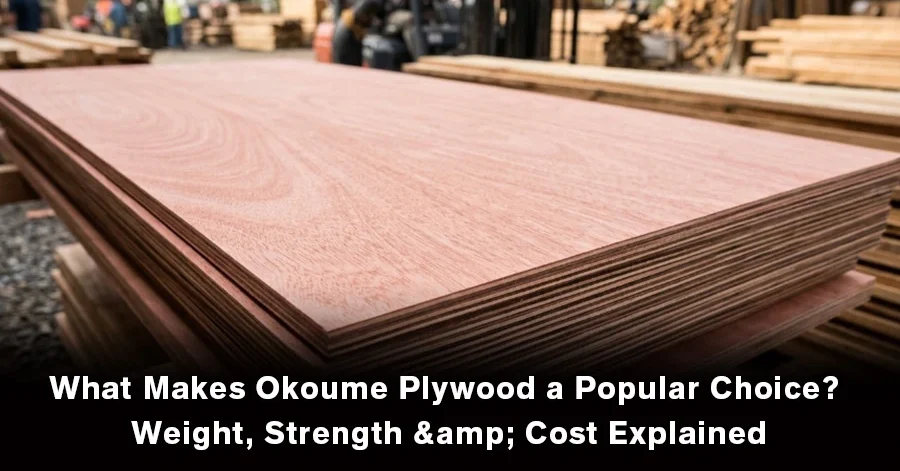
Okoume heartwood ranges from light orange-red to light reddish-brown. It usually has a straight and fine grain. The wood has few knots and relatively consistent coloring. It can be used as a decorative surface material. It can also be further processed through staining and veneering. This makes Okoume suitable for many interior styles. These styles range from natural wood designs to modern luxury interiors.
In short, Okoume plywood offers excellent peeling and processing performance. It also provides a stable panel structure and attractive natural grain. In addition, it offers good cost efficiency. These qualities make it a versatile choice for large-scale manufacturing, decorative applications, and commercial purchasing.
Why Is Okoume Plywood Lightweight?
Okoume plywood is relatively lightweight, making it a practical choice for applications where low panel weight is important.
- Low wood density: Okoume has an air-dry density of approximately 0.48–0.55 g/cm³ (480–550 kg/m³). Its density is similar to pine and significantly lower than many common hardwoods, such as rubberwood, elm, and mixed hardwoods. This makes Okoume a naturally lightweight wood species.
- Plywood construction: Commercial Okoume plywood typically uses Okoume veneers for the face and back, while the core is often made from materials such as poplar or eucalyptus. During production, the veneers are dried and pressed to reduce excess moisture and eliminate internal gaps. This creates a more stable panel while allowing the finished plywood to retain much of the lightweight characteristic of the original wood.
Why Is Okoume Plywood Relatively Affordable?
Okoume plywood is generally considered an affordable and cost-effective plywood option. It is sometimes described as an alternative to walnut and is widely used as a cost-effective material for plywood production and custom cabinetry.
- Large supply and relatively low import costs: Okoume is mainly sourced from countries such as Gabon and Cameroon in Central and West Africa. It is an important commercial timber species in the region and is sometimes referred to as the “King of African Woods.” Compared with scarce and expensive hardwoods such as American black walnut, cherry, and Burmese teak, Okoume is available in larger volumes and generally has more competitive raw material costs, helping keep the overall plywood price lower.
- High veneer yield and low material waste: Okoume logs are typically tall and relatively straight, with large diameters and relatively few knots. These characteristics make the logs well suited to rotary peeling. The resulting veneer is relatively smooth and flexible, with good resistance to splitting, allowing manufacturers to achieve a high veneer recovery rate. For plywood manufacturers, this means less raw material waste and higher production efficiency.
- Excellent workability saves processing costs: Okoume is a lightweight and relatively soft wood, making it easy to cut, sand, glue, and finish. It also dries relatively quickly and can be processed efficiently when proper drying and manufacturing conditions are maintained. Its easy workability can reduce processing time, energy consumption, and tool wear, helping manufacturers control production costs.
- Its physical properties are better suited to core and back applications: Okoume is relatively soft and has lower surface hardness than many dense hardwoods, so it can be more susceptible to scratches and dents. It also requires appropriate treatment and protection when used in humid or pest-prone environments. For this reason, Okoume is commonly used as a plywood core or back veneer, as well as in cabinet components, interior doors, moldings, and other applications where lightweight construction and easy processing are more important than high surface hardness or heavy load-bearing performance. Its typical application range also helps keep Okoume plywood positioned as a cost-effective material rather than a premium hardwood product.
Where Is Okoume Plywood Used?
Thanks to its combination of low weight and good workability, Okoume plywood is used in a wide range of applications, including:
- Boat and yacht construction
- Kayaks and canoes
- Furniture and cabinetry
- Interior wall and ceiling panels
- Doors and partitions
- Decorative panels
- Lightweight structures
- Transportation and specialty components
The best plywood specification depends on the actual application. For example, a furniture manufacturer may prioritize surface appearance and machining quality, while a boat builder may focus more on bonding performance, durability, thickness, and marine suitability.
How to Choose the Right Okoume Plywood
Before purchasing Okoume plywood, buyers should consider several factors.
First, check the application. Determine whether the plywood will be used for furniture, interior decoration, boat building, or another purpose.
Second, confirm the thickness and dimensions. Common sizes can be selected for standard projects, while custom sizes may be available for specific production requirements.
Third, check the face and core quality. Veneer quality, core construction, surface sanding, and thickness tolerance can significantly affect the final product.
Finally, confirm certifications and testing requirements. For international B2B purchases, buyers may need documents related to FSC, emissions, bonding performance, or other market-specific requirements.
Why Choose Okoume Plywood?
So, what makes Okoume plywood a popular choice? The answer is its balance of lightweight performance, useful strength, easy processing, attractive appearance, and competitive cost.
It is especially valuable when reducing weight is important without moving to a material that is difficult to machine or finish. From boat building and furniture to interior applications, Okoume plywood can provide a practical combination of performance and efficiency.
For buyers comparing plywood options, the right choice should ultimately depend on the application, required performance, quality grade, certification, and total project cost rather than price alone
Looking for a reliable Okoume plywood supplier for your next project? AEWWOODS provides Okoume plywood for boat building, furniture, cabinetry, and interior applications, with flexible specifications to meet different project requirements.
📩 Contact AEWWOODS today for Okoume plywood specifications, samples, and a competitive quotation. Let us help you choose the right plywood for your application and export market.